

Today’s Briefing

News, Blog & Events for the Renewable Energy Industry

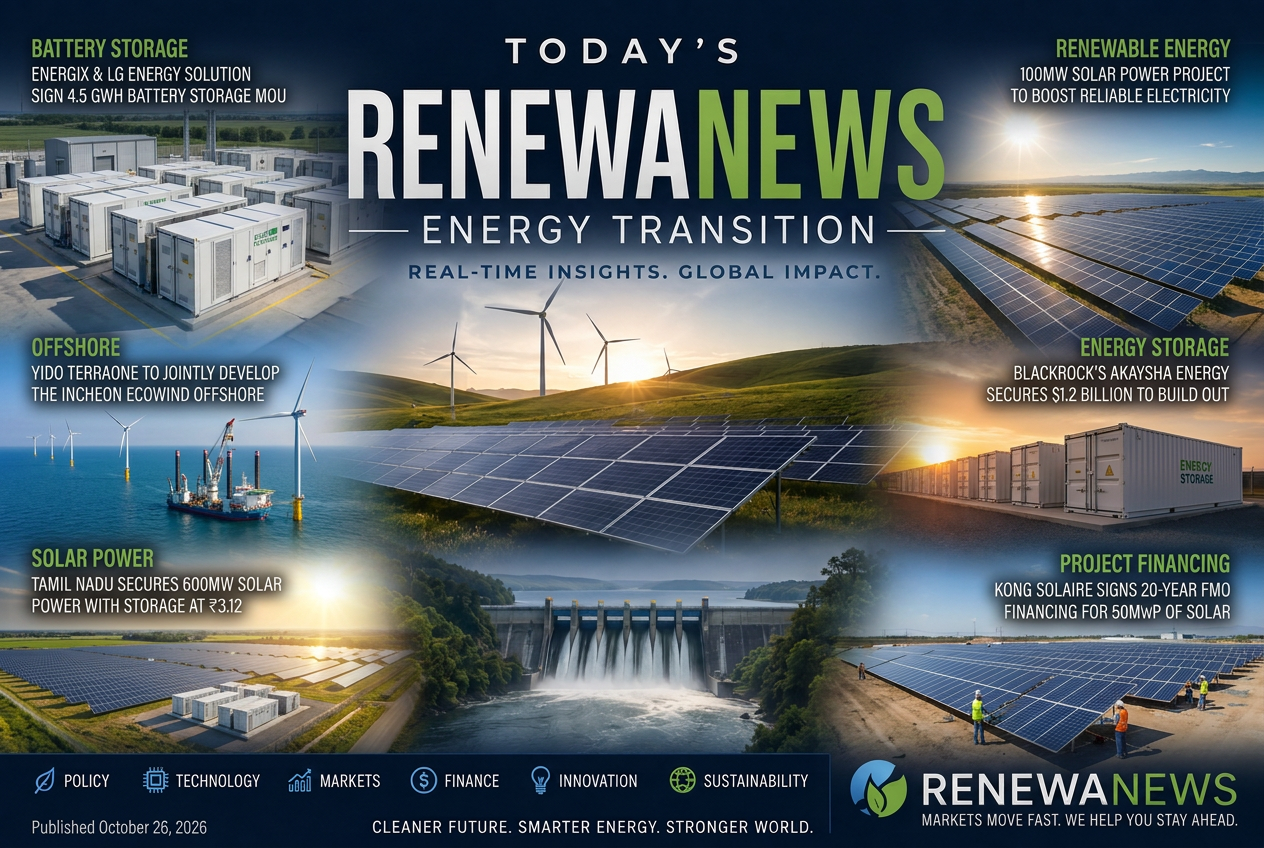
Illustrated summary of the top stories in the RenewaNews Briefing — September 5, 2026 briefing

Sunday, September 6, 2026

Energy overtakes land as biggest data centre bottleneck

Power access is becoming the main constraint on new data centre builds, which points to a tighter link between digital infrastructure growth and grid capacity. The shift puts pressure on utilities, transmission planners and developers to secure reliable electricity faster, with direct implications for renewable supply and storage where operators are trying to meet larger round-the-clock demand.

Get the daily briefing

Join the professionals who start their day with RenewaNews.

Iran's renewable energy power plants' production potential revealed

Iran’s renewable power sector appears to have measurable generation capacity, but the headline gives only a broad indication rather than a project-specific update. The implication is that Iran is still assessing how much clean electricity its wind and solar fleet can contribute to the grid, which matters for supply, emissions reduction, and future investment planning.

OQAE, Asyad Explore Green Hydrogen for Mobility in Duqm | Oman Hydrogen - News and Statistics

OQAE and Asyad are testing how green hydrogen could support mobility use cases in Duqm, which points to early-stage demand planning rather than immediate large-scale deployment. The effort matters for Oman because transport fuel switching depends on built-out production, storage, and refueling infrastructure, not just hydrogen supply.

Nepal wants to be a clean-energy powerhouse. The indigenous people are paying the price

Nepal’s clean-power buildout is colliding with land rights and the treatment of indigenous communities. The story points to a familiar risk in hydro-heavy and other infrastructure-led transitions: projects can advance emissions goals while shifting costs onto local people, which can slow permitting, trigger opposition, and weaken the social license needed for large-scale deployment.

Cubans Turn to Solar Power and Improvisation Amid Fuel Blockade

Cuba’s fuel constraints are pushing households and businesses to rely more on small-scale solar and practical workarounds to keep electricity flowing. The story points to a broader lesson for energy transition policy: when imported fuel is scarce, distributed solar can improve resilience, but only if equipment, maintenance, and grid support are available.

Record-low reservoirs and a drought-stricken Canada are quietly pulling the plug on America's hydropower foundation, and the clean energy future that depends on it

Drought and falling reservoir levels are cutting into hydropower output in North America, with ripple effects for grid reliability and low-carbon power supply. The story matters because hydropower often helps balance variable solar and wind, so sustained water stress can make clean-power systems harder and costlier to manage.

Red Sea Destination Achieves Full Renewable Energy Commercial Operation - News and Statistics

A renewable-energy utility package has reached commercial operation for the Red Sea destination project, indicating that clean power systems are now moving from construction into use. The development points to continued deployment of utility-scale renewables in the Middle East for large destination and infrastructure projects, with implications for lower emissions and more reliable local power supply.

Get the daily briefing

Join the professionals who start their day with RenewaNews.

Digital public infrastructure and the future of renewable energy: insights from India Energy Stack

India’s renewable buildout is increasingly tied to digital public infrastructure, which suggests the next stage of clean-energy growth will depend not only on generating power but on organizing data, coordination, and market access. For solar and other renewables, that points to better integration with grids and customers, and potentially lower friction for scaling deployment.

After nearly two decades of failed attempts, Maine's wind power ambitions are closer to reality than ever before — regulators just approved 800 MW of turbines and a transmission line shared by four states

Maine’s offshore wind plans have cleared a major regulatory hurdle, with approval for 800 MW of turbines and a multistate transmission line. The decision matters beyond the state because it advances large-scale wind buildout and the grid connections needed to move power across New England.

Showing 1–25 of 634

← PreviousPage 1 of 26Next →